A Portuguese startup that has just closed a Series A has budget to grow and, almost always, little presence in AI assistant answers, which is where a B2B buyer may now draw up the first list of suppliers. The order destaque.ai recommends is to measure first, build the entity next, and only then produce content: measurement is what tells you which questions are worth spending the round on.
Why it is different from an established company
A ten-year-old brand has history: articles, directories, forum mentions, pages the models read in training. A startup has little of that, and the numbers show the effect. In the study destaque.ai published in May 2026 on 45 Portuguese B2B SaaS companies, 56% (25 of 45) were not recommended by any of the four engines measured, and 31% were completely invisible: neither mentioned nor recommended.
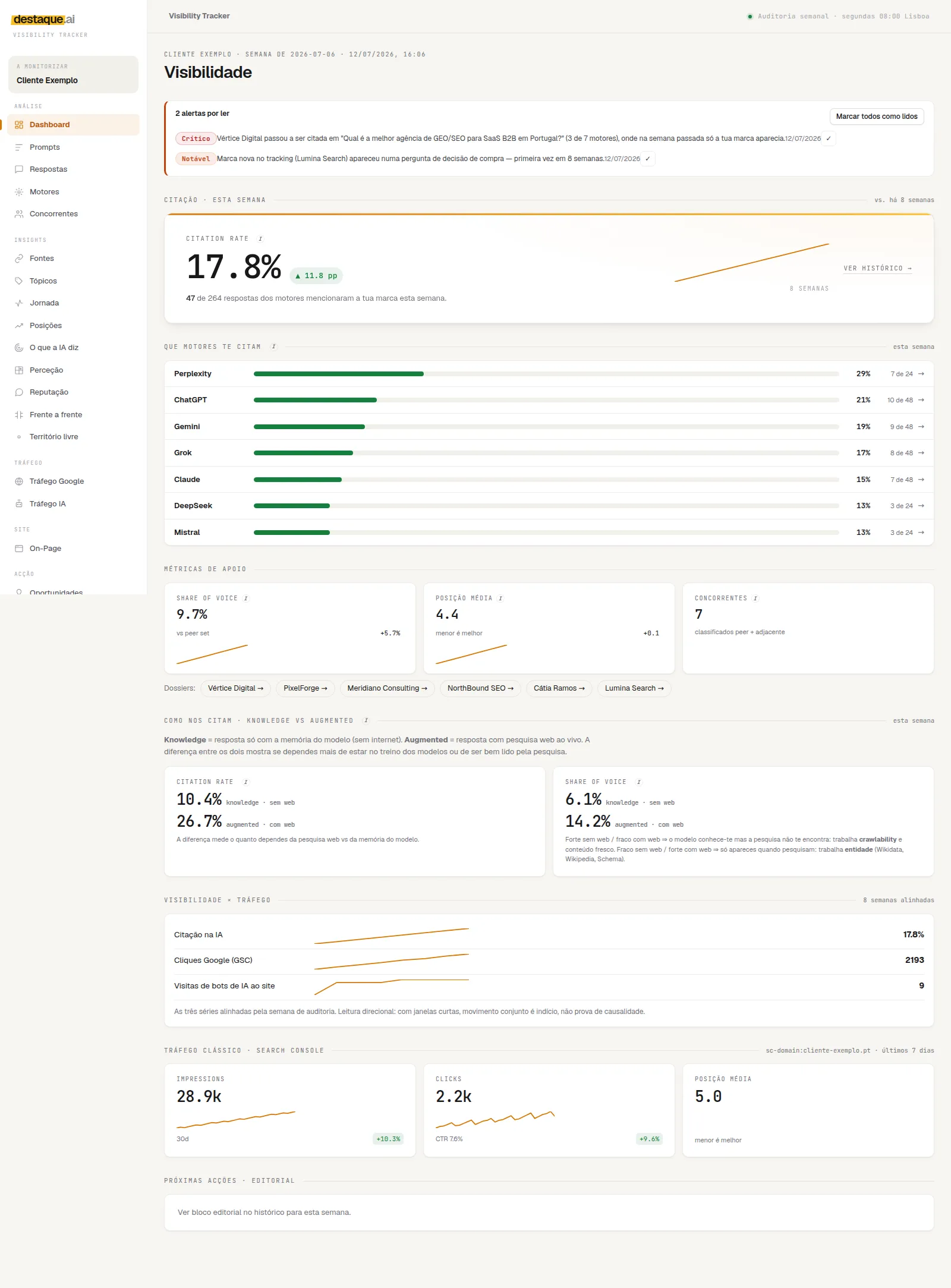
The difference lies in the two routes by which an engine reaches a brand. In the model's memory, what it knows without searching, a recent brand barely exists. In web search, a page published today can be read within weeks. destaque.ai itself is the example: in the week of 28 September 2026 it was cited in 0 of 324 answers in memory mode, and all its citations came from answers with search. For a startup, the search route is the one that moves first.
Where to start
1. Measure before producing. The questions a buyer asks before knowing the brand (what problem do I have, what alternatives exist, what criteria to use, who to shortlist), run across several engines, with and without search, and repeated, because the same question does not always give the same answer. The result is the baseline: where the brand appears, where it is chosen, and who appears in its place. The method is in how to measure GEO.
2. Close the technical foundation. It is the cheapest work and the most forgotten. In the same study, 96% of the SaaS companies (43 of 45) had no AI crawler policy in robots.txt, 58% did not publish llms.txt and 58% did not declare the company in Organization schema. The robots.txt configuration is in llms.txt vs robots.txt, and the schema minimum in schema.org for B2B SaaS.
3. Use the round to build the entity. A Series A usually brings what a startup rarely has: independent press coverage. That is precisely what Wikidata and Wikipedia require before accepting a brand, and what the engines use to confirm who it is. The order matters: first the public references, then the item. destaque.ai learned this the hard way: its Wikidata item was created without references and deleted on 11 August 2026 for lack of notability. What an entity is, and why it weighs, is in entity authority.
4. Write for the questions measurement showed you losing. Not more pages about the product, which answer "what do you do", but pages that answer the questions before the choice: honest comparisons, selection criteria, the problem explained before the solution. Each page opens with the answer, and the brand name goes in the sentence that answers, not at the end.
What to measure in the first 12 weeks
- Citation: in how many answers the brand appears, by engine and by mode (memory and search).
- Recommendation: in how many it is chosen, not just listed. Appearing in a list of ten is not the same as being the answer.
- Share of voice: what slice of the category's mentions belongs to the brand, and who holds the rest.
- Sources: which pages each engine reads to answer. That is where the brand has to be in order to be read.
The questions stay fixed for the 12 weeks. Changing them midway confuses a change in the question with a change in the brand's presence. The week-by-week calendar is in the first 90 days with a GEO consultancy.
What not to expect
Guaranteed positions: the models do not sell places, and whoever guarantees them is making it up. Entry into the models' memory in three months: it depends on training cycles, which cannot be controlled. And a Wikipedia article without prior independent coverage: eligibility comes from the press, not from the request.
To close
The round brings budget and brings press. Used in this order, measurement first and content after, both buy presence in the questions that matter. Used the other way round, they buy pages no engine cites. If the question is doing it in-house or hiring, the criteria are in GEO consultancy or in-house team.
See also: The State of AI Visibility for Portuguese B2B SaaS, 2026 (the data cited in this guide); Memory versus search (the two routes by which an engine reaches a brand); and How much a GEO consultancy costs.