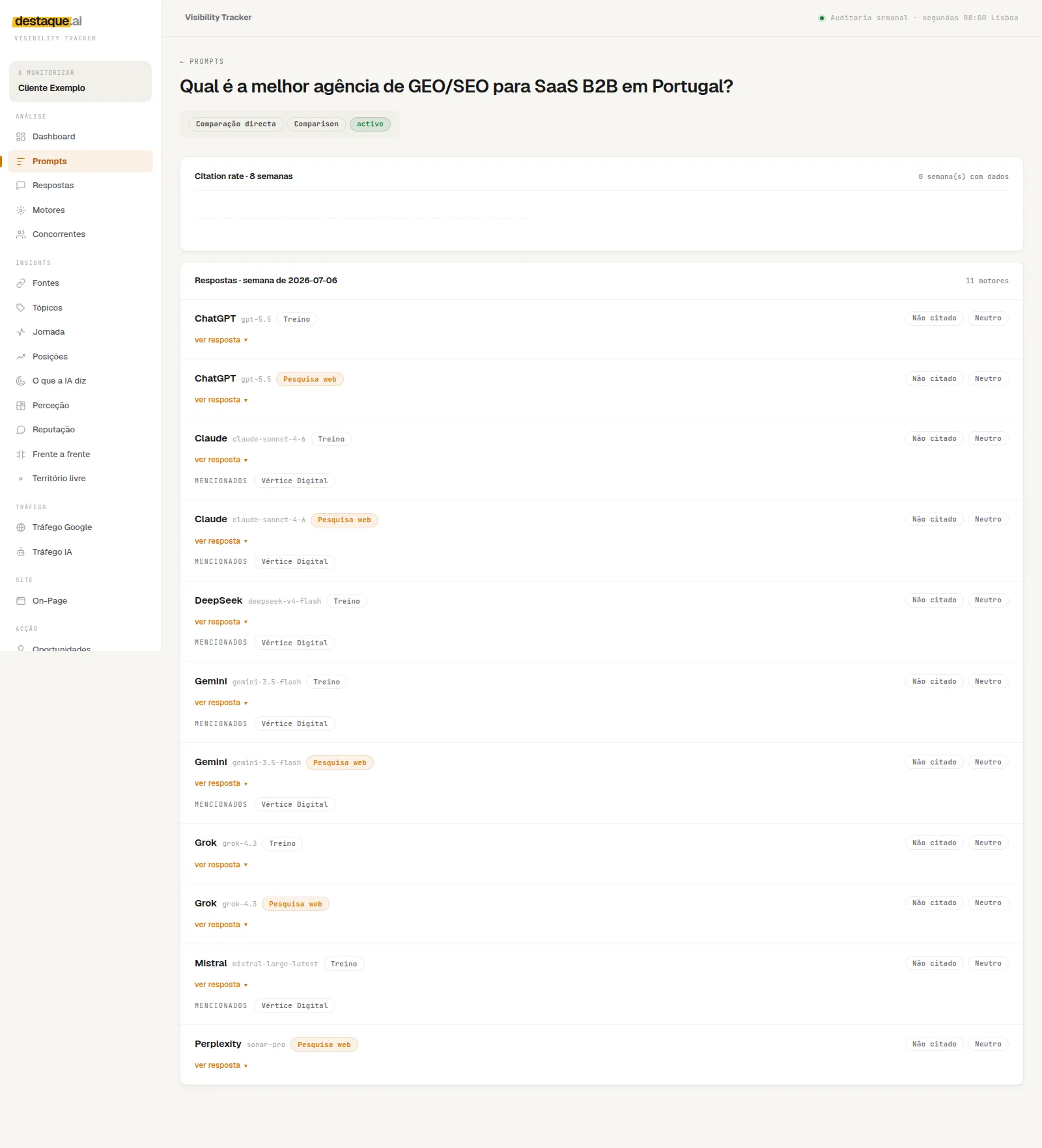
Ask ChatGPT the same question twice. The first time with web search off. The second time with search on. You will probably get two different answers, with different brands. It is not a bug. They are two modes of operation, and most brands only think about one of them.
They are called knowledge and augmented. Understanding the difference is understanding why your brand can be recommended by one assistant and completely absent from another, or from the same assistant at different times.
The two modes, without the jargon
Knowledge is the answer from memory. The model answers from what it learned during training, without going to the internet. It is a portrait of what your brand was at the model's training cut-off, and of how often it appeared in the sources it read. If you were notable in those sources, you appear. If you were not, the model does not invent you.
Augmented is the answer with live search. The assistant searches in the moment, reads pages and cites them. Here what you were a year ago does not count; what counts is whether you are well indexed, crawlable, and whether your content is extractable now. It is closer to the world of classic SEO, but with the AI citability filter on top.
The same question, two regimes, two sets of signals. And this is where most diagnoses fail: they measure one and assume the other.
Knowledge and augmented, side by side
| Knowledge | Augmented | |
|---|---|---|
| Answers from | Memory: what the model learned in training | Live search: it reads pages and cites them |
| Goes online | No | Yes, in the moment |
| What counts | What the brand was at the training cut-off, and how often it appeared in the sources | Being well indexed, crawlable, with extractable content now |
| What it measures | Accumulated reputation | Current technical hygiene |
| The fix | Entity authority | Technical hygiene |
| Pace | A game of months | A game of weeks |
Why you appear in one and not the other
The asymmetry is not random. It follows predictable patterns:
- Recent brand, technically well built. Wins in augmented (indexed, citable now) and loses in knowledge (has not yet built up presence in the training sources). It is the typical profile of a new SaaS, or of a local brand that put its technical house in order this year.
- Older brand, unmaintained. The opposite. It shows up in knowledge because it was notable in the past, but slips in augmented, because the site is slow, badly structured, or not crawlable by AI crawlers.
- Local brand. Rarely shows up in knowledge: the models have little memory of local entities. In augmented, everything depends on the Google listing, the reviews and the directories. For most brands with a physical place, augmented is the game that matters.
The practical reading: knowledge measures your accumulated reputation; augmented measures your current technical hygiene. They are different problems with different solutions, and treating them as one is the quickest way to waste work.
What each mode tells you to do
Once you separate the two, the action plan almost writes itself:
Your diagnosis, and what to do
- Weak in knowledge, good in augmented
- Your problem is authority and entity. You need external mentions, consistent presence in sources the models will read in the next training round (Reddit, publications, directories, Wikidata), and time. It is a game of months.
- Good in knowledge, weak in augmented
- Your problem is technical and immediate. Indexing, schema, performance, llms.txt, extractable content. It is a game of weeks, and the return is fast.
- Weak in both
- Start with augmented (cheaper, faster) and build the authority in parallel for the next knowledge round.
- Good in both
- Defend the position and measure the competitors, because this is exactly where they will try to get in.
Why almost nobody measures this
Measuring one mode is already work: you run questions, count mentions, compare with competitors. Measuring both, across several engines, comparably over time, is serious work, and that is why most tools and agencies simplify it into a single visibility number that hides the very asymmetry that matters.
The correct measurement is simple to describe and demanding to carry out: the same set of questions, in each engine, once with search off and once with search on, across several runs, with citation rate, share of voice and position measured in each regime. The difference between the two is the diagnosis.
In short
The AI does not have one answer about your brand. It has two: the one from memory and the one from search. Appearing in one does not guarantee appearing in the other, and the work to fix each is different: entity authority for knowledge, technical hygiene for augmented. Any AI visibility diagnosis that does not separate the two modes is telling you half the story.
This is exactly the distinction Periscopy measures, across the engines and AI surfaces it covers, in both modes, week after week.
Frequently asked questions
What is the knowledge mode of an AI assistant?
It is the answer given from memory, from what the model learned during training, without going online in the moment. It reflects what the brand was at the model's training cut-off and how often it appeared in the sources it read.
What is the augmented mode?
It is the answer given with live web search: the assistant searches in the moment, reads pages and cites them. It rewards whoever is well indexed, crawlable, and has extractable content now, not in the past.
Why does a brand appear in one mode and not the other?
Appearing in knowledge depends on having been notable in the model's training sources, which accumulates over time. Appearing in augmented depends on current technical SEO and citability. A recent brand can win in augmented and lose in knowledge; an older brand without technical maintenance can find the opposite.
How do you measure visibility in the two modes?
You run the same set of questions in each engine, once with search off (knowledge) and once with search on (augmented), across several runs, and measure citation rate, share of voice and position in each regime. The difference between the two is what shows where the problem is.