See what AI says about you. Then change the answer.
Periscopy is a market intelligence tool for the layer where AI decides. Every week it puts your buyers' own questions to the engines, and tells you where your brand stands in the answers, who wins instead of you, which sources produced that result, and what to change. From the buyer's question to the visitor landing on your site.
We read every answer, from every engine, one by one. We work out what produced it: which sources the AI read, what it searched for before answering, where in the decision the buyer was. On top of that we run predictive models that point to where the decision is still open and where your brand can get in before anyone else. And we do not only look at you: we run the whole market, the competitors, the sources, the communities, the press and the brand’s own entity. That reading is what makes the brand evolve, week after week.
A destaque.ai product
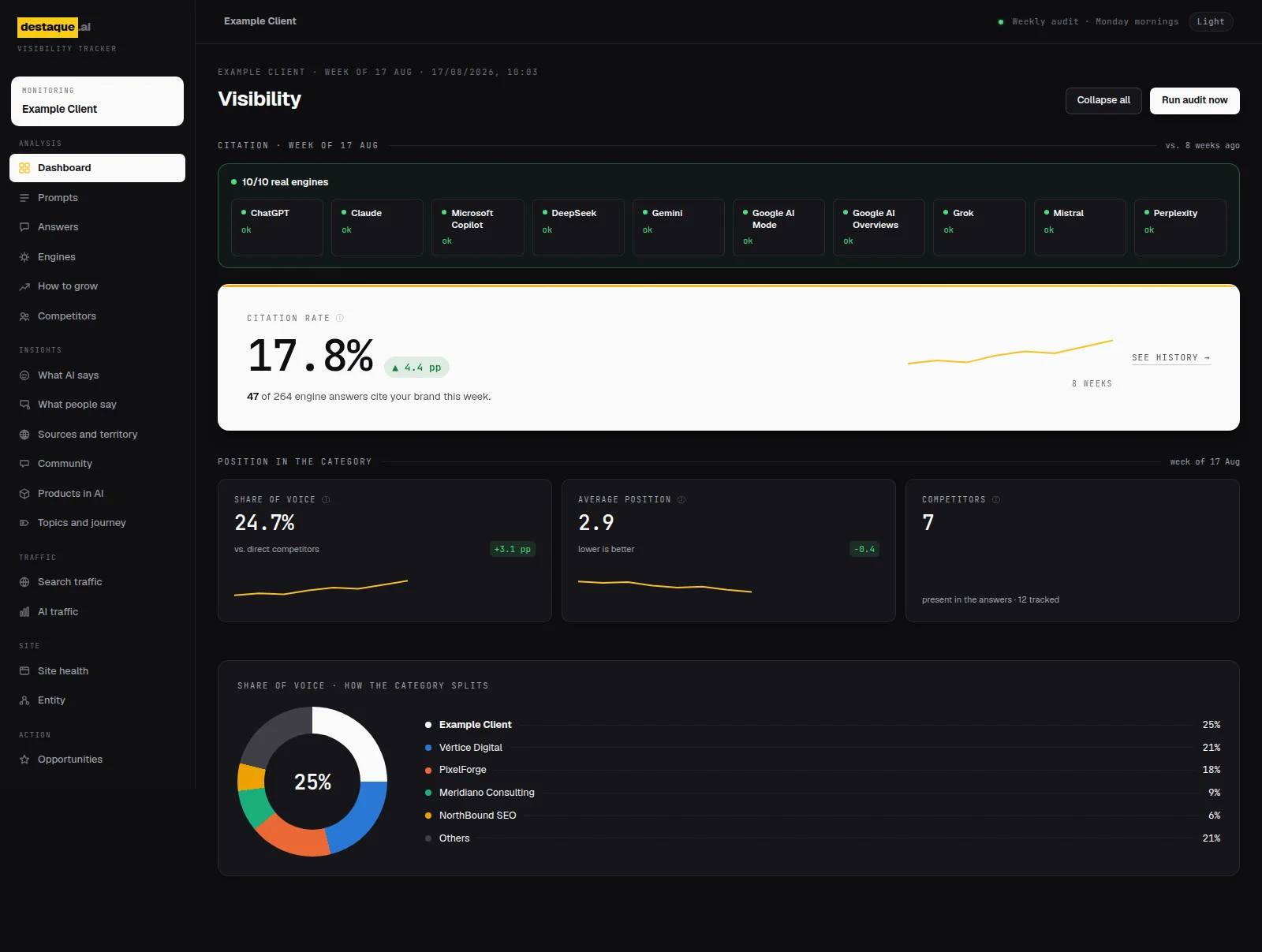
Every screenshot on this page shows the real product with demonstration data. The monitored client (Example Client), the competitors, the domains and the numbers are fictional. The product works in English end to end: interface, weekly report, PDF, alerts and CSV export.
~1.2×
Visitors arriving from AI convert above organic search. And AI-driven conversions grew +6,432% in a year.
-58%
The click on Google's first position drops to less than half when an AI block sits on the page. The sale gets decided inside the answer.
62%
Of the brands in a first answer vanish at the buyer's second question. Whoever survives the follow-up keeps the shortlist.
Sources: NetElixir 2025 · Ahrefs, 300,000 keywords, Feb 2026 · Clovion, 69,120 B2B conversations, 2026. Your brand's own number is the one we measure: answer to visitor, before and after every action.
Running the models is the easy part. The rest is the stack.
Any tool can ask a model questions. Periscopy runs ten collection and analysis systems crossing into the same weekly read, and that depth is what cannot be copied in a weekend.
01 · AUDIT ENGINE
Eleven engines and surfaces, two modes per engine (model memory vs live web search), every week, with full history. Two numbers, not one: share of voice, which divides the mentions, and share of recommendation, which divides the choices. Being on the list and being the answer are counted apart.
02 · PRESS, COMMUNITY AND SOCIAL MONITOR
The press read every day, plus Reddit with comments, Hacker News, local forums and the networks (YouTube, LinkedIn, Instagram, TikTok, X), in the rooms that matter for your brand. Every mention classified by relevance and sentiment, and cross-checked against what the engines cited: it separates noise from sources that decide purchases.
03 · CRAWLER ANALYSIS
The AI robots (GPTBot, ClaudeBot, PerplexityBot) visiting your site, cross-referenced with your visibility in answers. You watch the machine read you before it cites you.
04 · SOURCE GRAPH
Which domains feed your category's answers, with co-citation, down to the exact place inside the platform: the subreddit, the channel, the profile, the review page. We never say “get on Reddit”; we name the room, with the count of answers it fed.
05 · ENTITY ENGINE
Wikidata, Knowledge Panel, schema, sameAs: how machines identify you as an entity. The layer that decides whether models retain you in memory.
06 · COMPETITOR RADAR
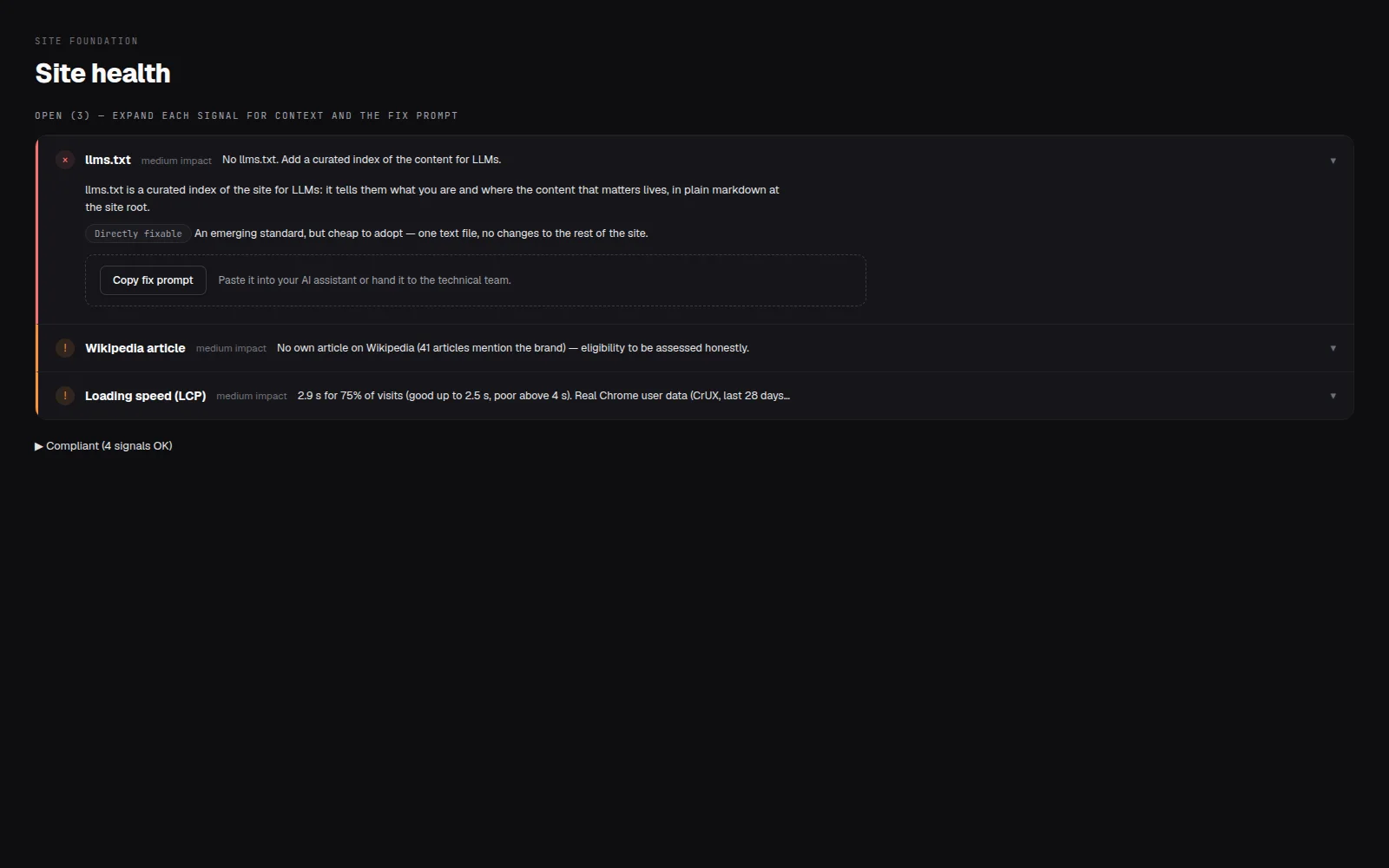
A dossier per competitor: where they appear, which sources feed them, moves, observed pricing, and the presence × narrative perception map.
07 · COMMERCE OBSERVATORY
The shopping carousels inside the assistants, observed the way a buyer sees them: title, brand, merchant, price, rating, position and the sponsored label, item by item. What no API shows, seen through the buyer's eyes.
08 · PROOF PER ACTION
Every completed action gets a date and a before/after citation reading. The plan is not a task list: it is a closed loop with measurement.
09 · OPPORTUNITY ENGINE
A proprietary intelligence layer reads every answer of the week and turns gaps into a plan: each opportunity is born from a measured source, mapped to the 8 SINAL dimensions and 4 horizons, with severity and effort.
10 · PREDICTIVE MARKET MODELS
Our systems learn from the data we collect every week: they record sources, cross layers, and detect patterns before they become trends. That is where the insights on unclaimed positionings come from: recommendations that are in no playbook yet, because they are born from your market.
Periscopy is not a dashboard. It is an intelligent agent working for your brand.
Every week, without being asked: it measures, reads, explains, decides what matters and prepares the pieces, with one goal: more buyers choosing you when they ask the AI. Eight things it does that you will not find in another product:
Explains every answer
Every answer carries its written why: why it cited you, or cited the competitor and not you, with the evidence of that answer (the sources, the route, who appears). Not a score; the reason.
Splits your business lines
Visibility broken down by your lines: the emergency-care question never mixes with maternity, nor the fuel station with the energy plan. Rate per line, who dominates each one, and where you are losing revenue blind.
Checks the facts
What the AI claims about you, checked against your recorded facts: prices, addresses, features, terms. A detected divergence becomes an actionable correction before a buyer reads it.
Measures by persona
The questions are not generic: each one goes out framed as a persona in the funnel, the decision-maker, the technician, the local buyer, at their stage. Visibility reads per persona, and segment focus gets decided through that lens.
Sets the target, and names the path
Pick the question that matters to you and declare what you want to change in the answer: be named, be the pick, or be tied to a theme. The agent says what to do from what is measured in that answer: the sources that engine read, and the words the buyer searched for. The starting point is kept from that day, and the next measurement says whether anything moved.
Declares what you want the AI to say
A target on one question serves one question. Some things run across thirty: the discount you want tied to a whole category, the guarantee that sets your offer apart, the argument that never shows up. Declare it once, apply it to the questions it serves, and the agent works towards it. With no public proof behind it, the first step is to write that proof: an engine is never asked to state what is not evidenced.
Shows who wins in each engine
Not only the competitors you declared: every brand each engine picks, including the ones nobody has classified yet. It is where the market moves in plain sight, because the brand entering your category shows up here weeks before anyone gives it a label.
Hands over finished pieces
Every action in the plan can ship as the final piece: the corrected copy, the structured-data block, the outreach email with its subject line. Your team applies; it does not decipher.
We measure where your buyers actually ask.
Weekly and automatic across all of them. Not an estimate: the real answer each engine gives.
Training memory (what the AI knows about you without the internet) and live web search (what it answers when it searches). The contrast between the two tells you whether the problem is the brand entity or presence on the web.
The questions a buyer actually asks, put to the engines in the voice of a persona (CEO, CMO, technical decision maker) and by decision stage. The persona is a framing we write and send ahead of the question. The same question also runs with no persona at all, to measure how much the persona changes the answer.
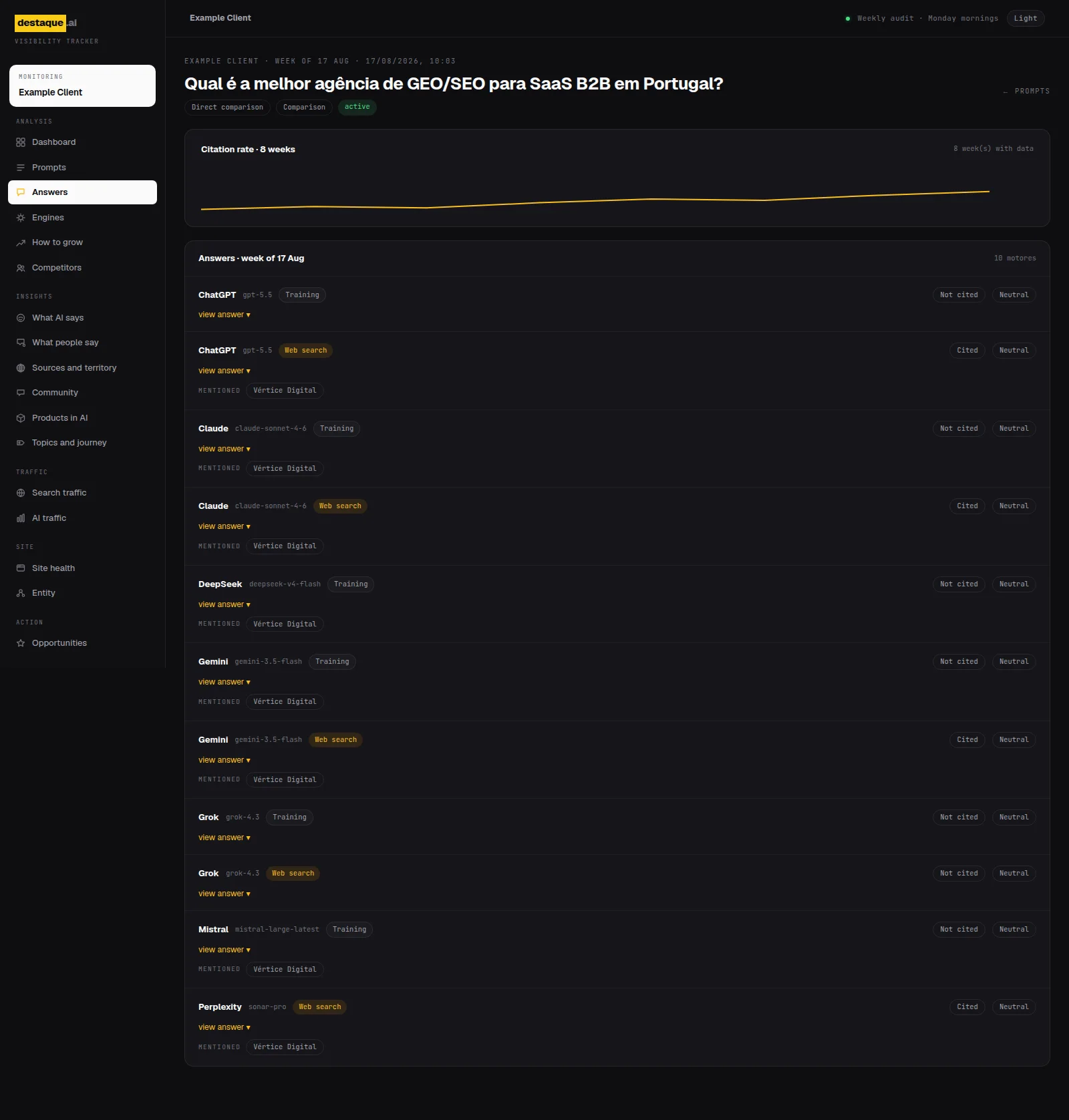
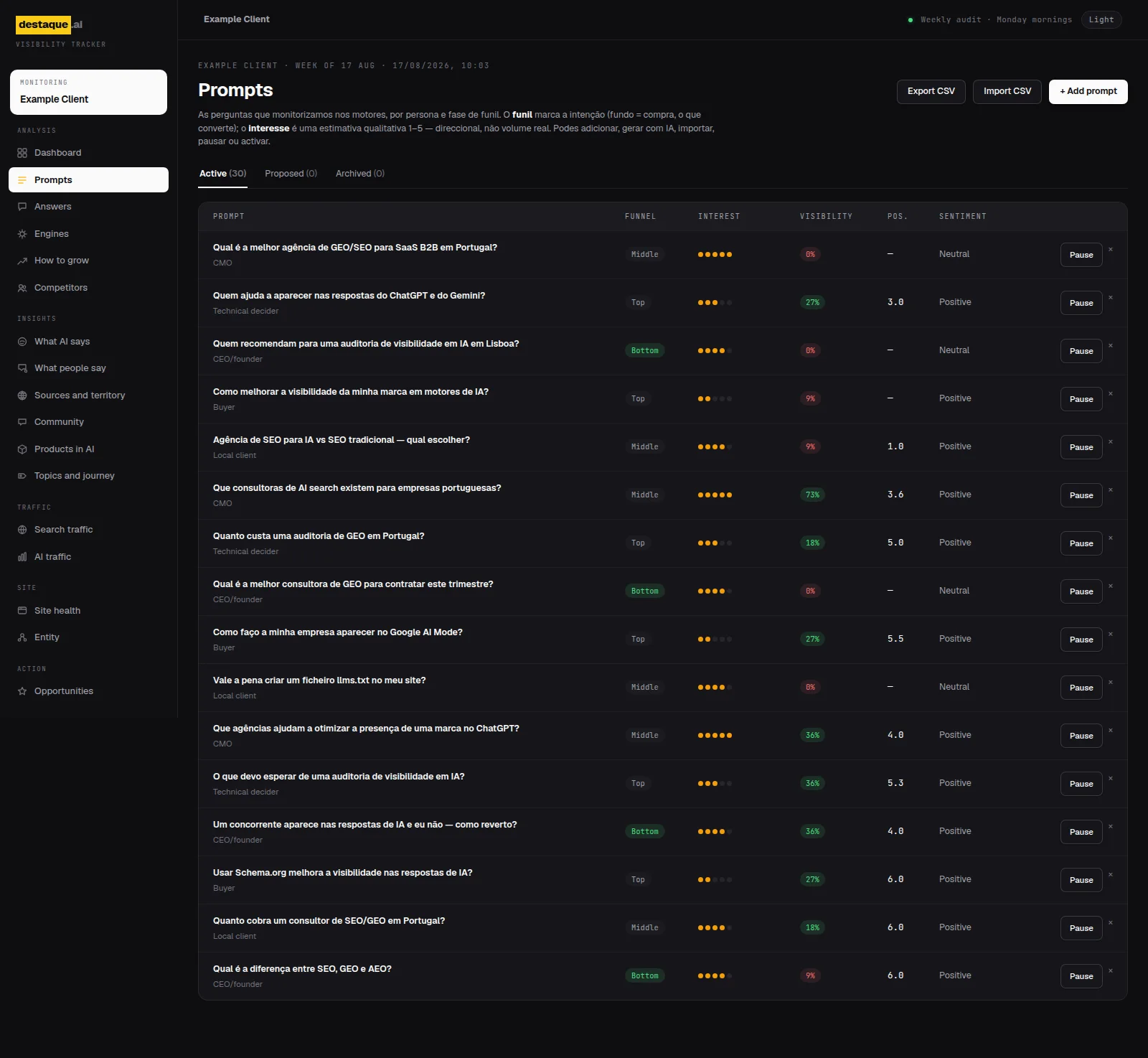
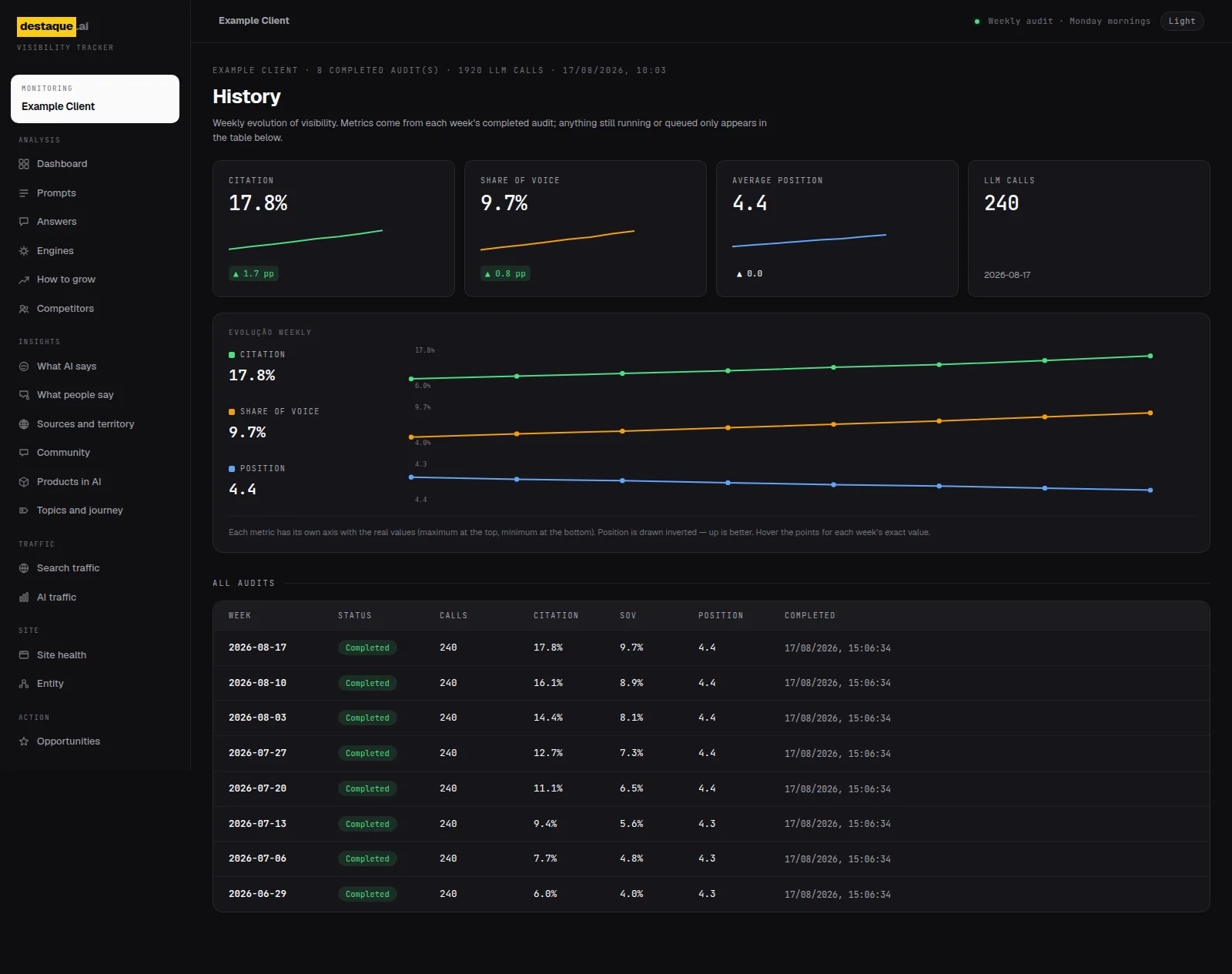
You see it in a live panel, not a monthly PDF.
Each answer from each engine, stored by week, with citation, position, tone and the competitors detected in that answer.
Search Console, AI bot visits to your site, and a correlation panel between visibility and traffic, side by side.
Monthly PDF report and a weekly email digest, with the highlights and one action for the week. CSV export of everything.
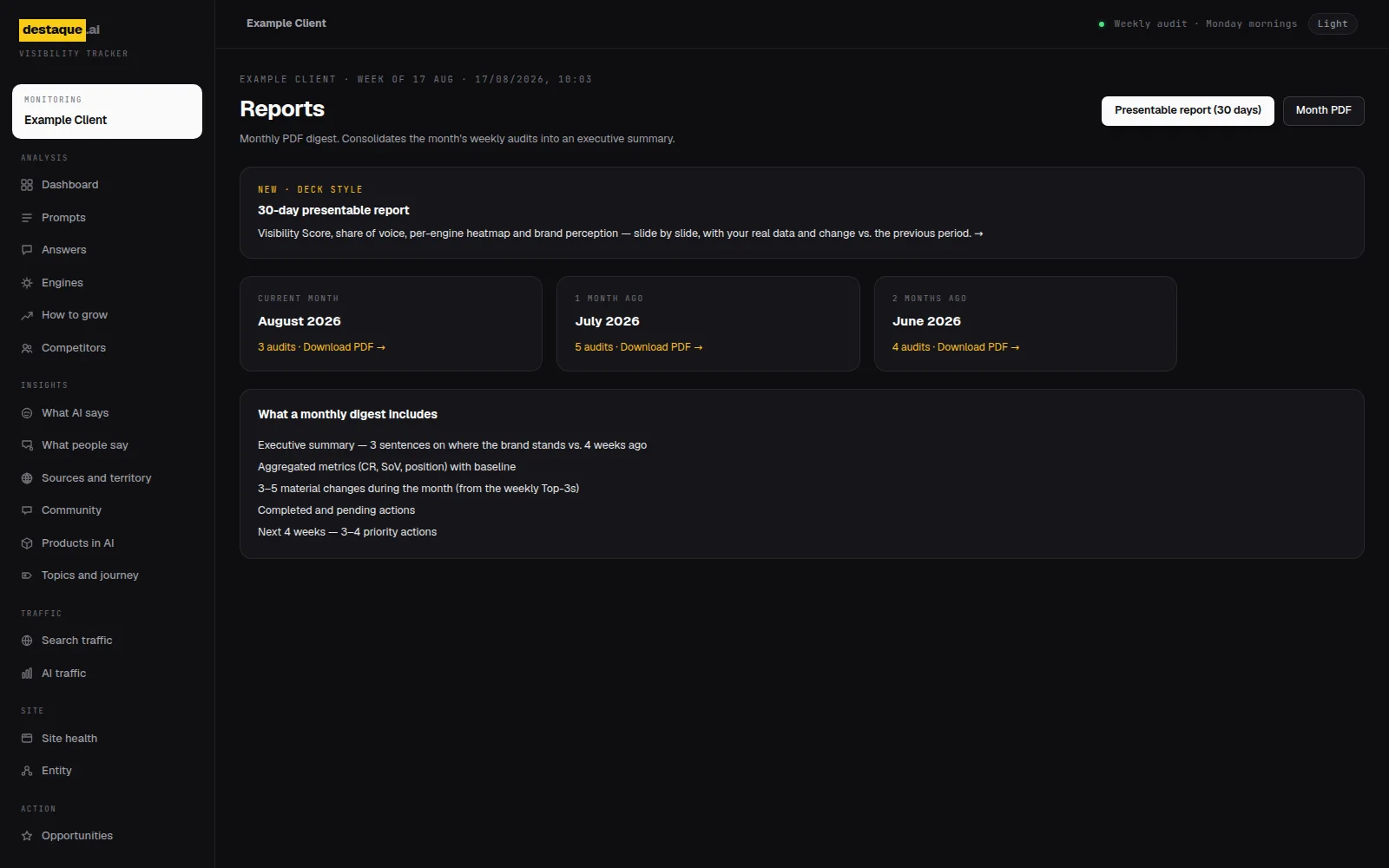
Your competition, mapped in detail.
Every name the AI mentions is classified: direct competitor, tool, or media. We do not count an SEO tool as a rival of yours.
Which engines cite it, the exact sources feeding those citations, the questions where it appears and you do not, real excerpts of how the AI describes it, and the share of voice trend, week by week.
Services it announces, who it sells to, content themes, channels where it is active (blog, LinkedIn, podcasts, press, reviews) and recent moves. Facts with a source, nothing else.
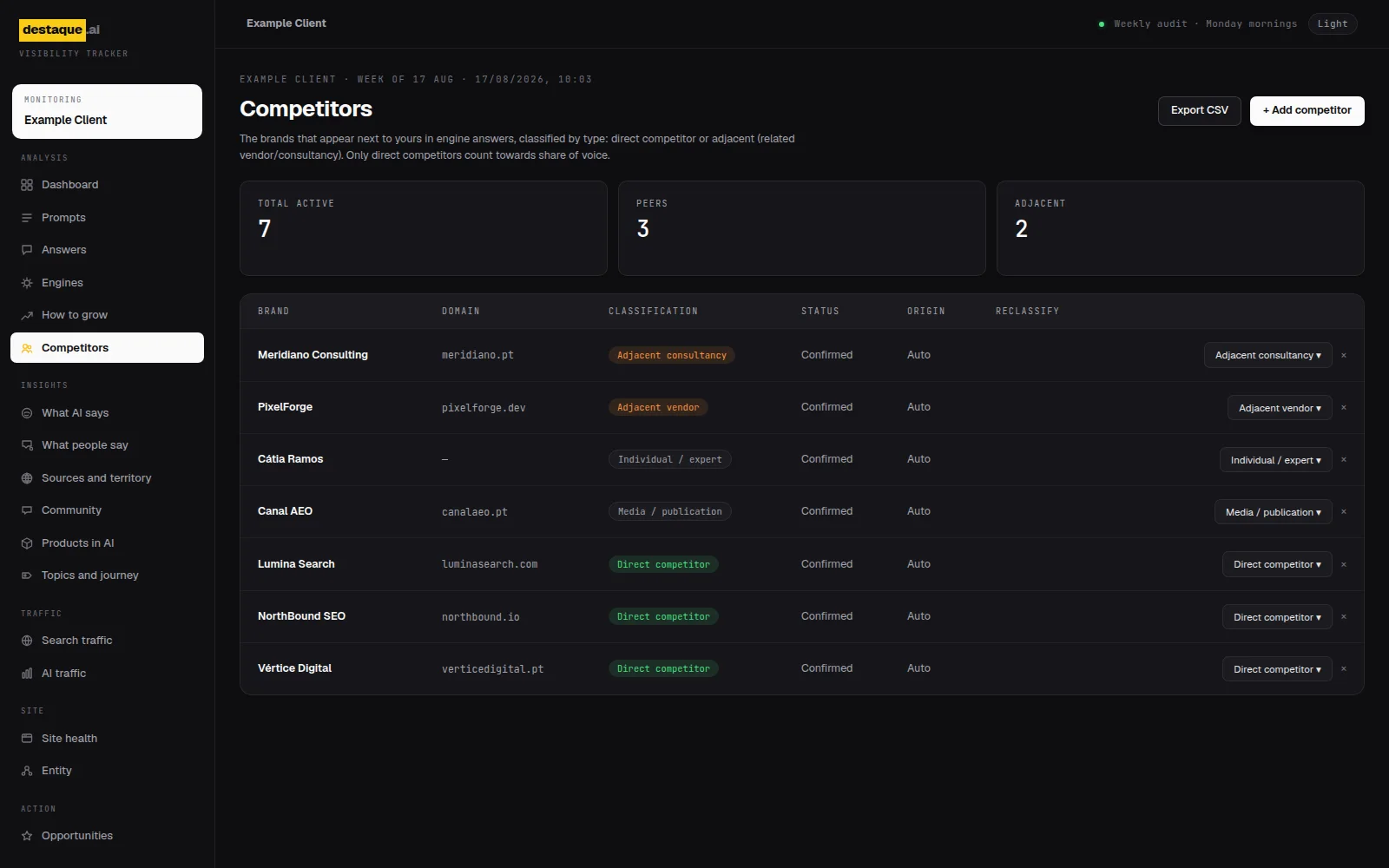
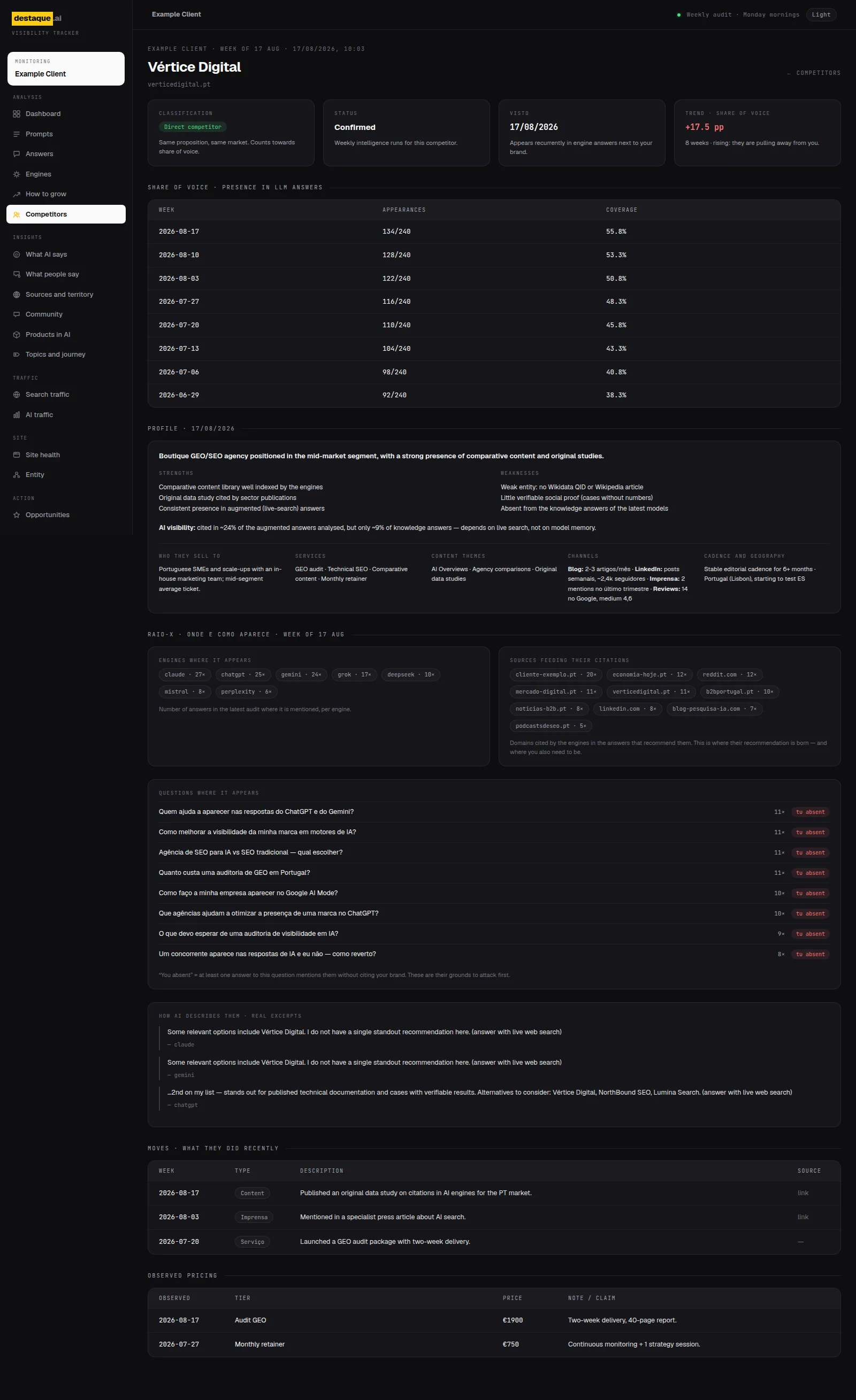
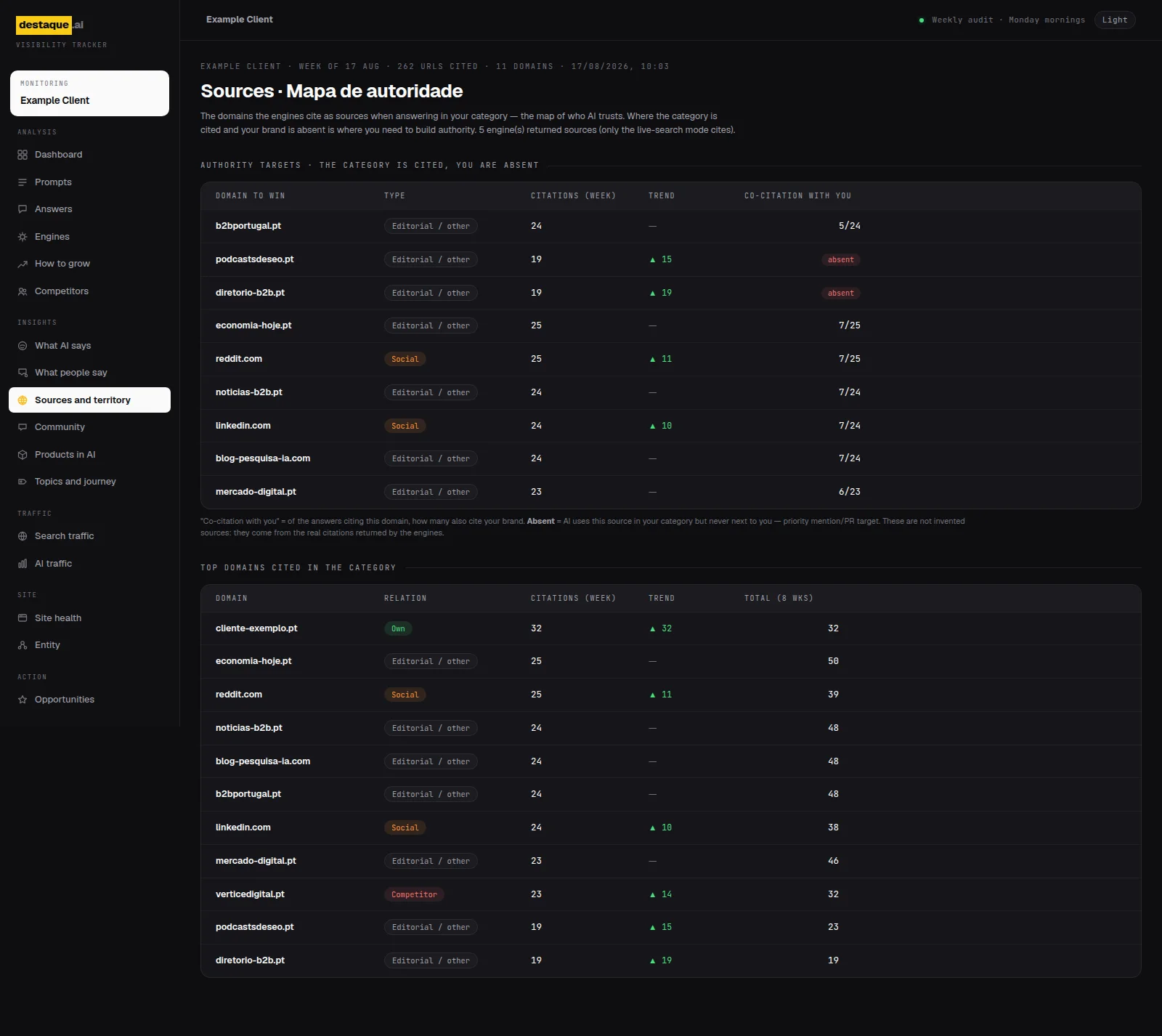
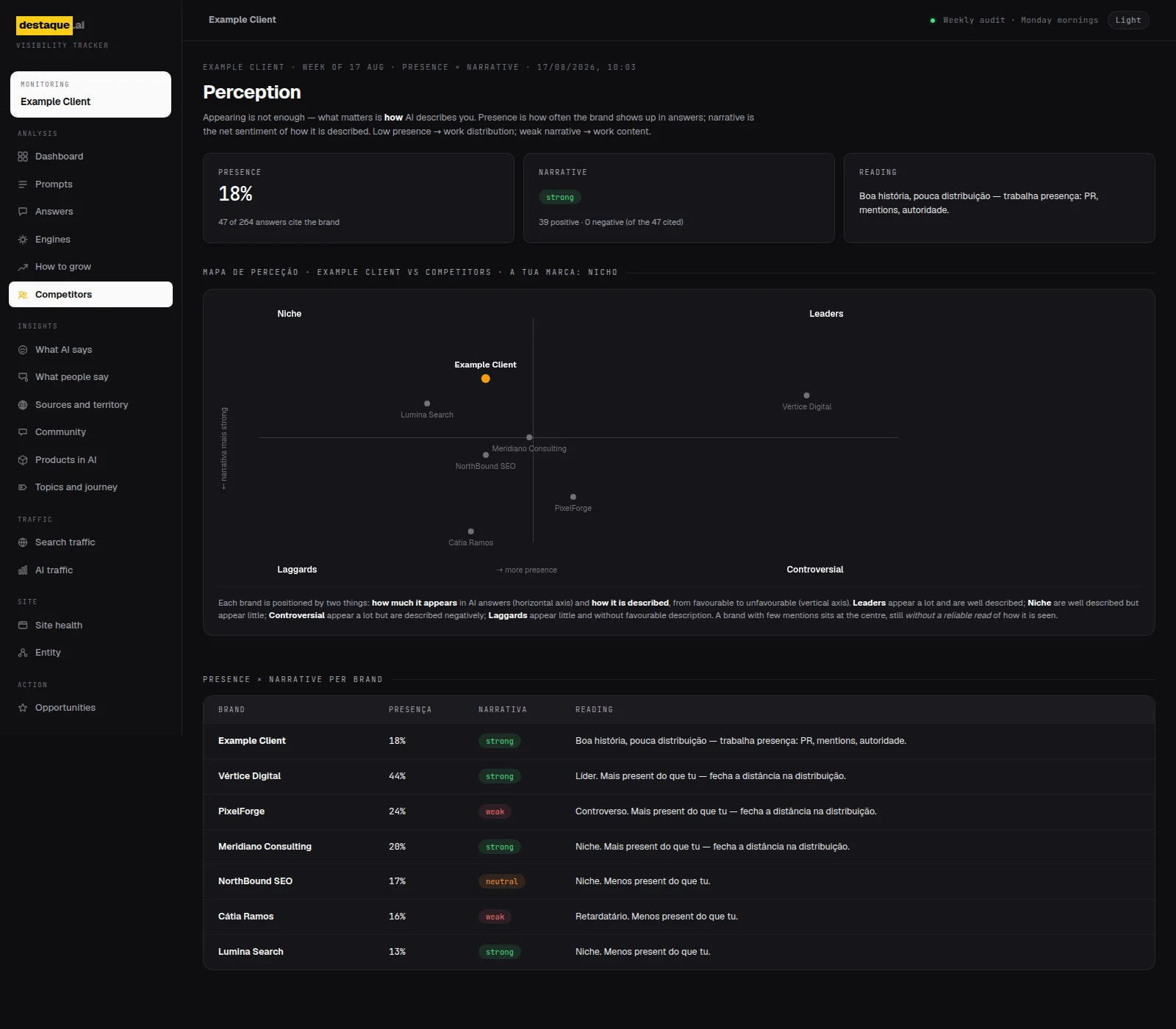
We tell you where there is room to win.
Not everything is taken. Part of the questions and sources in your category have no owner yet. Periscopy finds that territory and tells you when it changes.
Where the AI still recommends nobody. Whoever arrives first with quotable content takes the answer. Buying-intent questions are flagged as priority.
The domains the engines cite in the category where no competitor dominates: the cheapest way in.
When a competitor enters a question that was yours, when a new name appears in buying questions, or when an open question finds an owner.
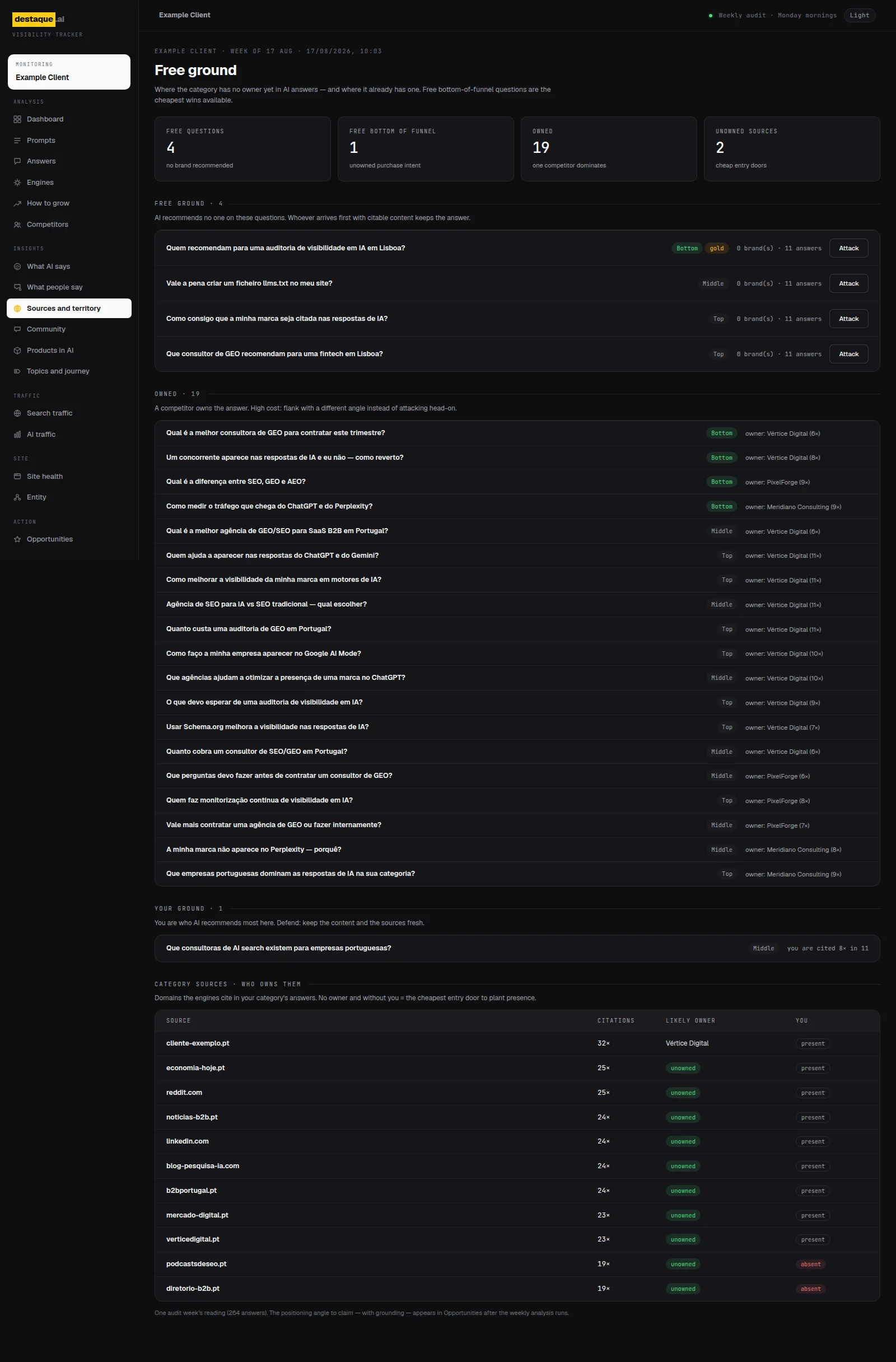
We close the loop: from analysis to proof.
Every open question has an attack button: it generates the brief of the content that can win it, with title, structure, and the sources where to plant presence.
Every gap tied to a concrete action, with severity and effort estimated. Appearing is not just a website problem, so the plan is not just technical.
Each completed action is dated, and the panel shows citation before and after it. Results measured, not promised.
- Horizon 1, weeks 1 to 2
- Horizon 2, weeks 3 to 6
- Horizon 3, weeks 7 to 12
- Horizon 4, 90 days and beyond
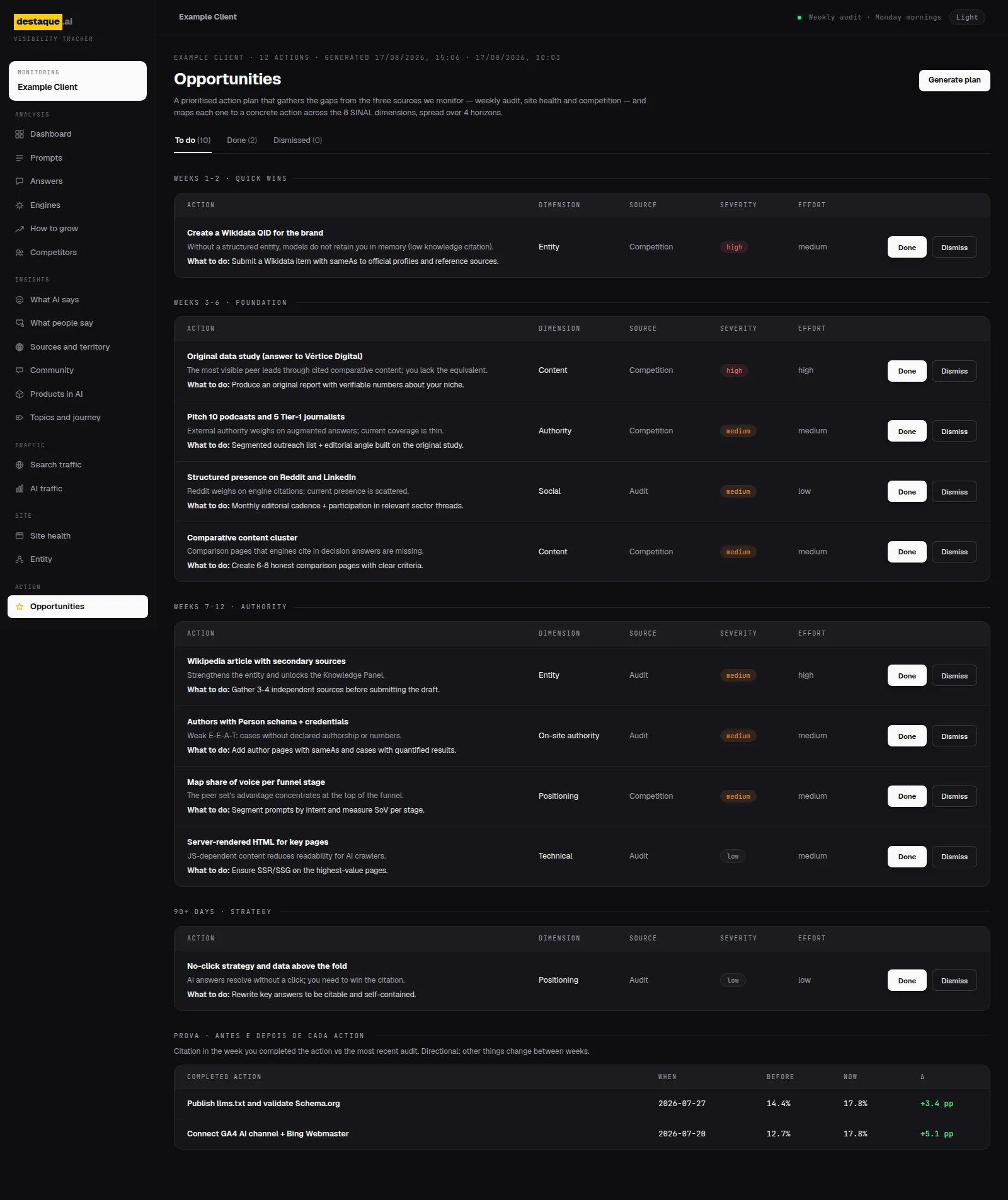
Your site, read the way the AI reads it.
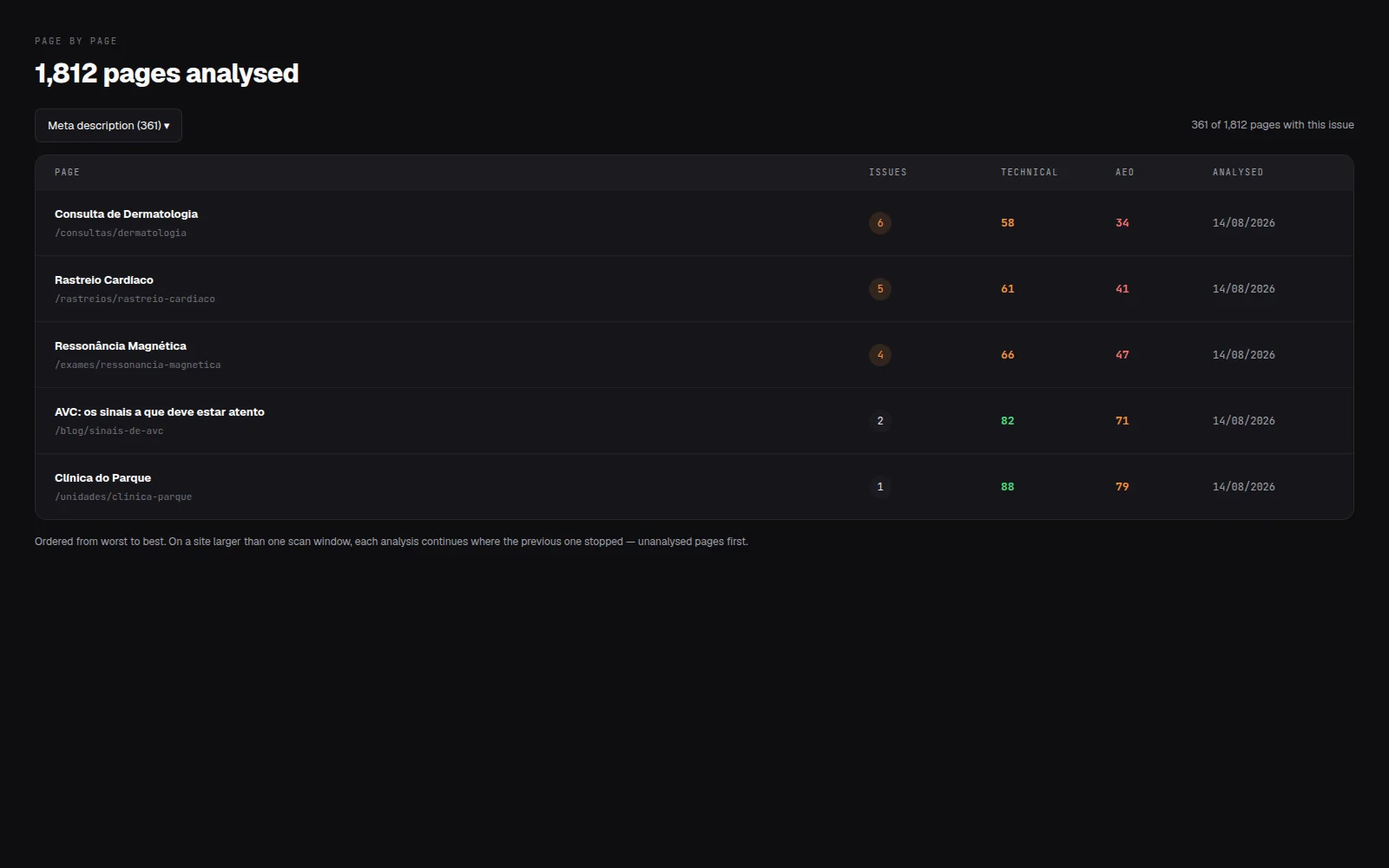
Beyond measuring where you are cited, Periscopy audits what the engines find when they reach your site: the foundation once, and then page by page, with no practical ceiling. A site of 2,000 pages is analysed in rounds that continue on their own.
Robots, llms.txt, structured data, entity. Each signal opens and explains itself: what it is, whether it is yours to fix or depends on a third party, and the correction already written.
Technical (can the crawler read it) and answering (does it answer what it promises), with the concrete problems and the fix for each.
What repeats across the site is aggregated. One duplicated title across 500 pages is a template problem, fixed once.
If you sell online there is one more layer. A shopping agent reads price, stock, delivery time and returns from your data, not from the page. We measure the fill rate across a sample spread over the whole catalogue, then product by product. In a catalogue of 10,000 items what counts is not the one lucky page, it is the percentage, which is where Merchant Center fails you.
Software and local brands.
SaaS, software, platforms, sites and e-commerce. When the buyer asks the AI about the category, you want to be one of the brands that appears.
Clinics, restaurants, tourism and retail. When someone asks for the best option in the area, your reputation and your Google listing decide whether you make it into the answer.
The same question changes answer depending on who asks it.
A technical director and a finance director do not ask the same thing about the same product, and AI does not answer them the same way. Asking “what is the best X platform” without saying who is asking measures an average that describes no real buyer.
The concept: a synthetic persona
A synthetic persona is a buyer written out in full and used as a variable in the measurement. It goes in front of the question, so the assistant answers as it would answer that person, rather than nobody in particular.
It is not a slide persona. A marketing persona lives on a deck and changes nothing; a synthetic persona is executable: it changes the question that goes out, and therefore the answer that gets measured. Two personas on the same product produce two different measurements, and the gap between them is the information.
Whether it is B2B or B2C, and which side of the table they sit on.
The sentence that goes in front of the question.
Feeds the generic and feature questions.
Feeds the comparison and objection ones.
Where the choice is played out.
The words THEY use, which are not the brand catalogue's.
The last field is the one most people forget. A brand describes itself in its own vocabulary; the buyer searches in theirs. Where the two do not meet, the brand does not show up, and it is not for lack of content.
An incomplete persona is a label, and the product says so. Every profile shows how much of it is filled in. A persona with only a name changes nothing in the measurement, and presenting it as though it did would be selling a reading that does not exist.
The limit, written down because it is honest: a synthetic persona is a hypothesis about a buyer, not the buyer. It does not replace talking to customers. What it does is make the measurement conditional and comparable: instead of an average that describes nobody, a result per profile, which can be argued with and corrected because it is all written down.
Before answering, AI runs its own searches.
When somebody asks “which GEO consultancy do you recommend in Lisbon”, the assistant does not go looking for that sentence. It breaks it into the questions it thinks it needs to answer first, searches each one, and only then writes. That middle step is the most actionable thing in this measurement, and almost no tool shows it.
Three things you only see here
If the question was about price and it searched for pricing table and how much per month, the page missing from your site has a name.
A question can be split into four. Appearing in one of the four is not the same as not appearing, and you know which one.
For every sub-question where you are absent, the domains it read instead of yours. That is the list of pages to write, in order.
The engine searches for brands by name before it knows what it will find. On another question that same week, about proven case studies, Gemini ran nine searches and six of them named a specific brand. That is the candidate list it already carries. Being on it is a different measure from being cited, and it comes first: what is never searched for cannot be found, and no work on the page fixes that.
Markets slip. On the same pricing question, ChatGPT ran a single search and it ended in “preço Brasil”. On a Portuguese question, that pulls competitors from another market into the answer your buyer reads.
Honest note: not every assistant declares this step. Where it is not declared, Periscopy says it did not see it, rather than counting zero.
If AI always searches the same way, there is a door. If it changes words, there is a market.
Week after week, the internal searches either repeat or they do not. The two mean opposite things, and both are actionable. If it converges on a handful of sources and terms, being in those terms is a finite job with an end in sight. If it brings vocabulary from outside your sector, the category has no owner yet: that is a window, and windows close.
The last line is the one that changes conversations. “We do not show up” and “we show up, it read the page, and it picked someone else” call for opposite work. The first is presence; the second is the page failing to convince, which is the most expensive problem and the easiest to hide.
The thresholds for what counts as much or little repetition do not live in the code: they live in the method, and they change when the measurement forces them to. What the product does is count; the reading is kept separate on purpose.
Being on a list of ten is not being the answer.
Almost every AI visibility measurement counts mentions. A mention can be your name in the middle of a list, and it can be the sentence “and the best of these is X”. Counting both the same way erases the one difference that matters to whoever is selling.
Present, or not. One answer, one yes or no.
The mentions in the category. Being one of three is worth more than one of twelve.
The choices in the category. Only answers where the assistant picks somebody count.
The denominator for choice is the answers that pick somebody. An answer that explains, lists and compares without picking has no pie to divide, and stays out. All three metrics use the same scale on purpose: two numbers read side by side have to be comparable.
Three real answers, and what each one is worth
These are answers about destaque.ai, measured by Periscopy itself. We use our own because the ruler we apply to others has to apply to us. The excerpts are translated; the originals are in Portuguese and unedited.
ChatGPT
Which is the best GEO consultancy in Portugal for a B2B SaaS?
my most defensible pick for a B2B SaaS in Portugal would be destaque.ai.
Perplexity
Which GEO consultant do you recommend for a fintech in Lisbon?
destaque.ai is worth evaluating; they claim to work out of Lisbon
Google AI Overview
How do GEO agencies in Lisbon compare?
Destaque.ai / Strategic B2B GEO / SaaS and tech companies / Focused on positioning complex solutions...
The criterion is not invented per client. It has been fixed in writing since the 616-answer study that produced it: a place in an ordering counts as a choice, so does a verdict on a criterion naming one brand, or the closing sentence. Belonging to the set (“the big three”) does not count, nor does a niche superlative. When in doubt, it does not count.
The distinction is no longer only ours. Marketeer, a Portuguese marketing publication, ran the study on 3 September 2026 using the same pair of words, under the headline “EDP is the Portuguese brand most chosen by AI”.
The report also reads inside your Claude or your ChatGPT.
Once connected, “what does my brand have to do this week” is answered from the report, not made up. Four tools, all read-only: the assistant reads what we measure and changes nothing.
How to connect. In Claude’s connectors, as a remote MCP server, with the address https://tracker.destaque.ai/api/mcp. Sign in with your Periscopy account, no key to paste, and each connection sees one brand only.
The Claude we measure is the Claude the buyer opens.
Almost all AI visibility measurement calls the models’ APIs. The API is not the product: in the app, search is always on, and the interface, the context and the way results enter the answer change what it cites. So the search half of Claude is measured in a real session, on a dedicated account, from Lisbon, with the same questions as the weekly audit.
The difference is measured. On the same questions, in August 2026, the two routes into Claude returned a different number of sources per answer (7 on one, 16 on the other) and only 24% of the brands named matched between them. Measuring by API alone measures a route the buyer does not use.
The other half stays on the API, on purpose. Search cannot be switched off in the app, so only the API measures what the model knows from memory. Claude’s card in Periscopy is half memory, via the API, and half search, in a real session. The same design reads Meta AI in a real session and keeps Amazon’s Rufus and the ChatGPT shopping carousel under observation, outside the count.
Your whole portfolio, under your brand.
Periscopy was built to measure several brands at once. An agency gets its own account, puts as many clients in it as it likes, and everyone on the team sees the whole portfolio. Clients of one account never show up to anyone outside it.
And the model is that the tool becomes yours. Not a report with our name on it: the whole product, with the agency’s logo, your house colours, the domain people log in through and the address the emails come from. Whoever opens the dashboard sees the agency. The measurement is ours; the tool in front of it is yours.
Every brand has its own questions, its own competitors and its own history. One brand’s measurement never leaks into another’s numbers.
The monthly report comes out as a PDF carrying the agency’s logo and the measured brand’s, ready to hand to the client.
Upload the logo, pick the colours, and the dashboard opens on the agency’s own domain. Whoever logs in to read the numbers sees the agency, not us.
Some agencies want the measurement and nothing else. Others would rather we read the numbers and carry out the fixes. Both are available, and the conversation starts in the same place.
Straight answers.
+Does it work outside Portugal?
Yes. Measurement is localised to your market: the Google and Bing surfaces are queried from your country and in your language, because a user in London does not see what a user in Lisbon sees for the same question. Reporting is in English.
+Do you measure through the API or through what a user actually sees?
Both, deliberately, because they measure different things. The seven language engines are measured through the direct route, under identical conditions every week, with no memory or personalisation contaminating the answer: that is what makes the series comparable over time. The search surfaces (Google AI Overviews, AI Mode, Copilot) are collected the way a user in your market sees them, real and localised pages. And on top runs the observatory: sessions inside the real ChatGPT app, meta.ai and Rufus, Amazon's shopping assistant, with a dedicated account, recording what only exists there: the shopping carousel, the displayed prices, the sponsored items. It is the layer that sees what no API shows. Whoever measures everything through a single method is adding up things that do not add.
+Which engines are monitored?
ChatGPT, Claude, Gemini, Grok, DeepSeek, Mistral and Perplexity, plus Google AI Overviews, Google AI Mode and Microsoft Copilot. The models run in two modes: training memory (what the AI knows about you without the internet) and live web search (what it answers when it searches). The surfaces are always live, because that is how a person sees them.
+How often does it run?
Weekly, automatically, on the same questions and the same engines, with the history kept. A single measurement is a snapshot; only the series shows direction.
+Can I see the actual answers?
Yes. Every answer from every engine is stored by week, with citation, position, tone and the competitors detected in that answer. Nothing is a summary you cannot open.
+How are competitors decided?
Every name the engines mention is classified: direct competitor, tool, or media. A laboratory, an insurer or a directory is not what your buyer chooses instead of you, so it does not count in your share of voice.
+Is the interface in English?
Not yet. The tool's interface is in Portuguese today, which is why the screenshots on this page are. What an English-speaking client reads is in English: the weekly report, the PDF, the alerts and the written analysis, plus the CSV export of everything measured.
See where you stand in the AI engines.
Fill this in and we handle the rest. We review the request, run the audit and send you the report. It is not automatic or instant: each audit is hundreds of real buyer questions put to the engines, and we look at them before sending you anything.
See your starting point.
The free measurement shows where you stand today across 11 engines and surfaces, against whom, and what we would do first. Thirty minutes, no commitment.