A technical GEO audit checks everything a technical SEO audit checks, and six more points that only AI visibility requires: whether AI crawlers get in, whether the content is in the HTML the server returns, whether the company is declared as an entity, whether pages open with the answer, the state of llms.txt, and whether citations are measured. It is the list destaque.ai applies in its audits, described below point by point, with what each one checks and why it counts.
What the SEO audit already covers
Indexing, canonicals, sitemap, speed, internal links, server errors. None of this stops counting: 54% of citations in AI Overviews come from pages already in the organic top 10 for the same question (BrightEdge, 2025, vendor data). A site Google does not index well is not cited either. The GEO audit starts here; it does not replace it.
The six points only the GEO audit checks
1. Whether AI crawlers get in. robots.txt has to distinguish the crawlers that answer questions in the moment (OAI-SearchBot, ChatGPT-User, Claude-SearchBot, Claude-User, PerplexityBot) from the ones that collect for training (GPTBot, ClaudeBot, Google-Extended). And reading the file is not enough: on a site behind Cloudflare, the AI crawler control can block with nothing in robots.txt. The configuration is in llms.txt vs robots.txt, and the commands to confirm each crawler really gets in are in how to check whether AI reads your site.
2. Whether the content is in the initial HTML. The text that matters has to be in the HTML the server returns, not assembled afterwards by JavaScript. A site that only shows its content after the browser runs code can do well on Google and be empty to a crawler that reads the HTML as it arrives.
3. Whether the company is declared as an entity. Organization schema with sameAs linking to the official profiles (LinkedIn, GitHub, Crunchbase, Wikidata), and Person with credentials for whoever signs. An empty sameAs is the most common failure in B2B. The minimum is in schema.org for B2B SaaS.
4. Whether pages open with the answer. The question in the title, the answer in the first paragraph, and the brand name in the sentence that answers. An engine that reads the page to answer takes the answer from a short block; if the name is three paragraphs down, the page is read and the brand is not said.
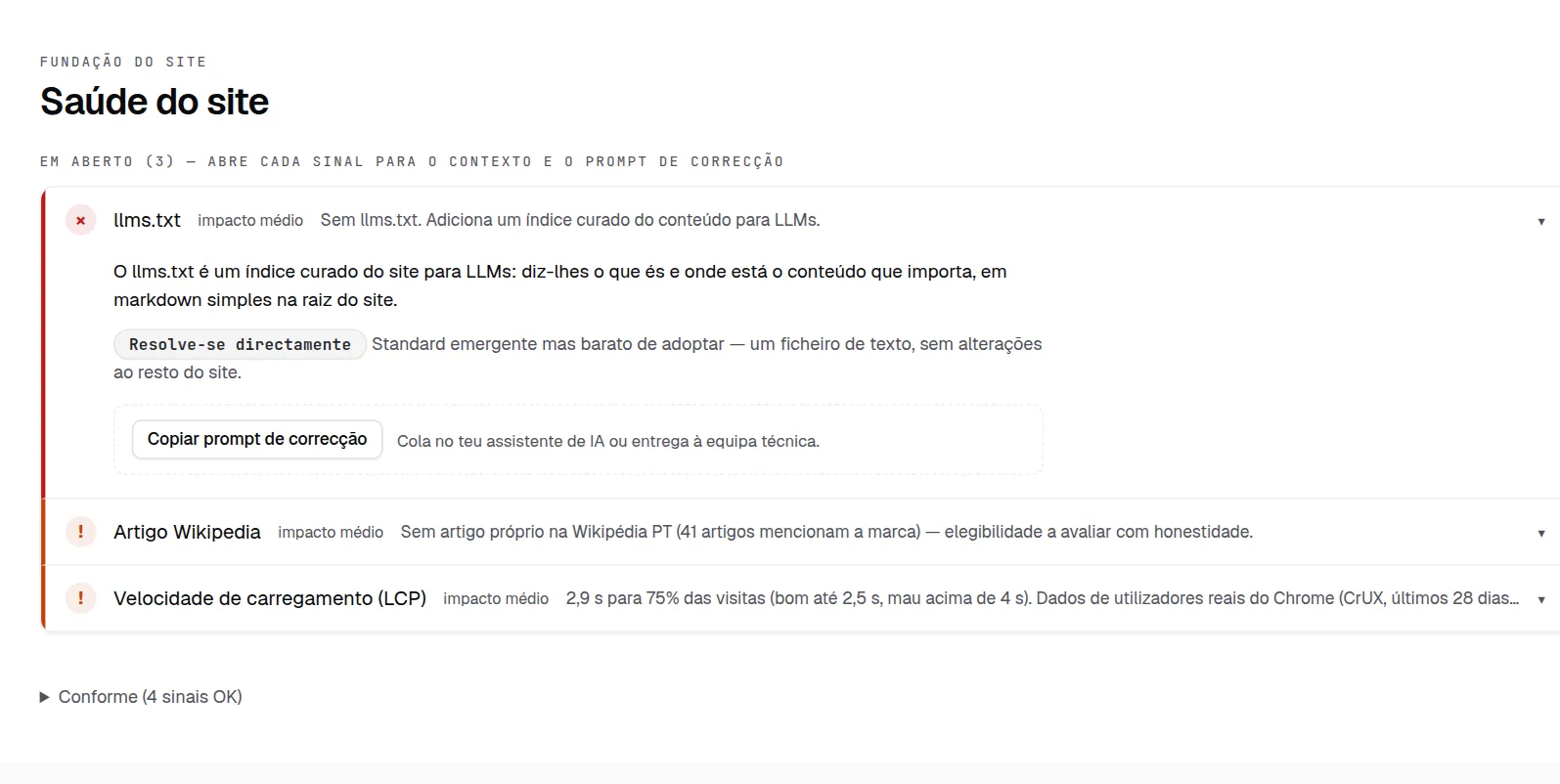
5. llms.txt, for what it is worth. Google has said publicly that it does not use it, and there is no confirmation that the large models read it when answering. It is cheap and useful for agents that look for it, so it goes in as hygiene, and an honest audit does not sell it as a lever. The format is in what llms.txt is.
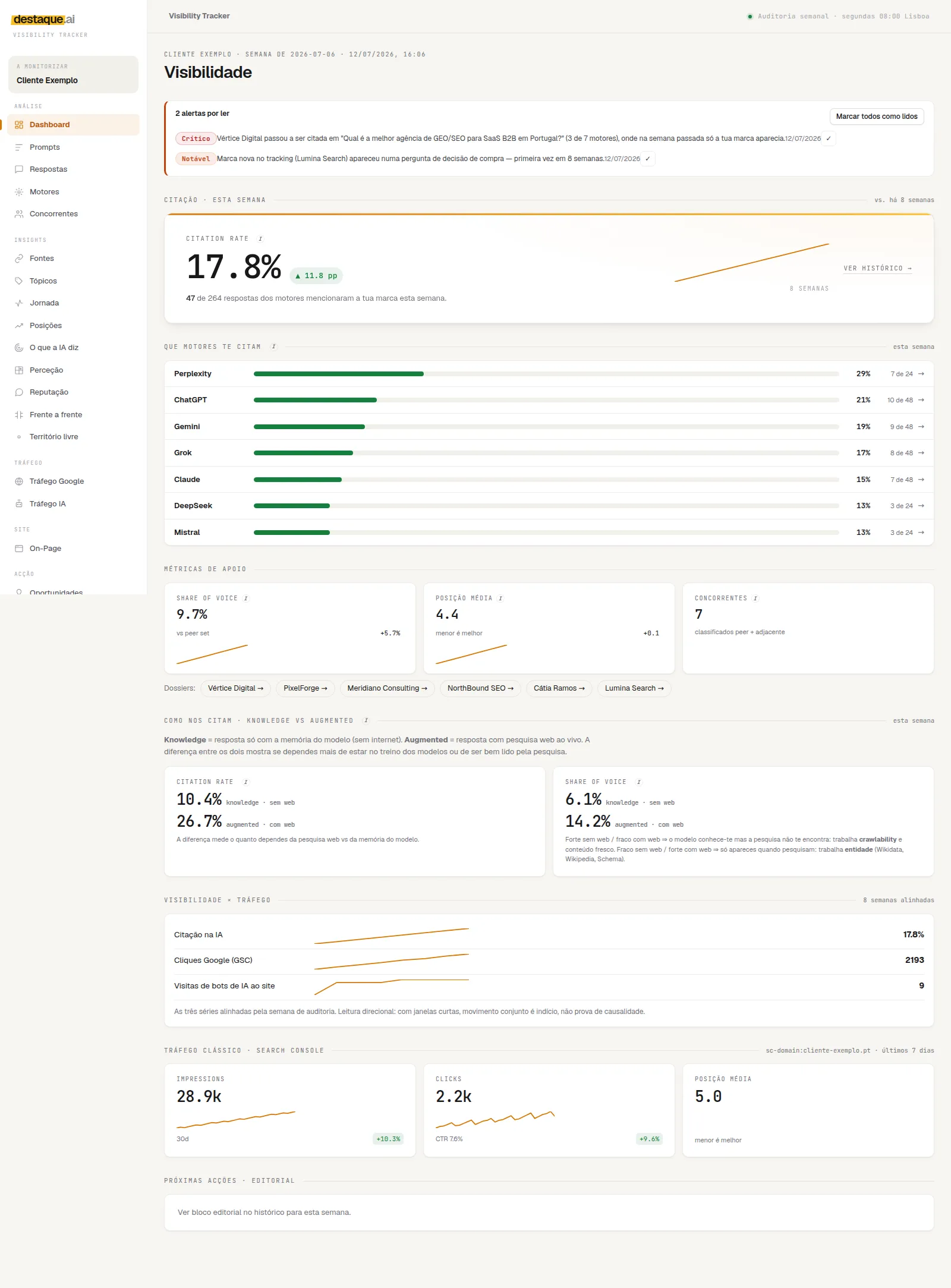
6. Whether there is measurement. Since February 2026, Bing Webmaster Tools shows the site's citations in Copilot and in Bing's AI summaries: it is the only AI citation telemetry from a major engine. It sits alongside Search Console, the AI channel in GA4 and the measurement of the answers themselves, with the same questions before and after the fixes.
What usually shows up
In the study destaque.ai published in May 2026 on 45 Portuguese B2B SaaS companies, 96% (43 of 45) had no AI crawler policy in robots.txt, 58% (26 of 45) did not publish llms.txt and 58% (26 of 45) did not declare the company in Organization schema. These are fixes that depend only on whoever runs the site, which is rare in this work: almost everything else depends on third parties.
What a technical audit does not solve
The technical part is one of the eight dimensions of the SINAL method. It opens the door, but it does not get the brand chosen: adding schema to pages that are already cited showed no effect on citation (Ahrefs, May 2026, vendor data), and what weighs next is content with original data, the entity recognised off the site and the authority of those who talk about the brand. An audit that only delivers the technical list delivers the first step.
To close
If you want to know how your site stands on these six points, the destaque.ai audit runs them and shows, alongside, where the brand appears today in AI assistant answers.
See also: How to audit a brand's visibility in AI (measuring the answers, which complements the technical side); The State of AI Visibility for Portuguese B2B SaaS, 2026 (the data cited above).